

The newest excessive stakes poker motion from The Lodge Livestream attracted loads of consideration earlier than a single card was even dealt. A lot of that curiosity got here from the return of Garrett Adelstein, who made one among his first main public poker appearances because the controversial J4 hand that dominated poker discussions for years. But by the tip of the evening, the largest story wasn’t Adelstein’s comeback however a memorable Alan Keating poker hand towards Doug Polk.
The desk was filled with acquainted faces. Alongside Adelstein sat Doug Polk, Alan Keating, Senor Tilt, and a number of other different regulars from the high-stakes livestream scene. With a lot expertise and aggression concentrated at one desk, huge pots felt nearly inevitable.
The sport started as a $100/$200 money recreation, however the motion shortly escalated. By the point the evening’s greatest hand happened, the stakes had elevated to $200/$400, creating considerably bigger pots and inspiring wider preflop ranges.
Whereas Doug Polk in the end received the biggest pot of the stream, the general session informed a special story. The signature loose-aggressive Alan Keating poker type prevailed as soon as once more, as he completed as the largest winner of the evening, reserving greater than $1 million in revenue throughout the eight-hour session. Polk additionally ended the sport within the black, whereas a number of different gamers endured important losses.
One of many greatest causes Keating remained the session’s high winner regardless of shedding a $650,000 pot was his willingness to play unconventional traces and put opponents in tough conditions. Satirically, that very same strategy would quickly lead him into probably the most talked-about hand of the complete stream.
Doug Polk and Alan Keating Conflict within the Greatest Pot of the Night time
The motion started with a stay straddle in play. Alan Keating entered the pot from the hijack by finishing to $800, and the motion folded round to Doug Polk within the small blind.
Holding 85 , Polk determined to use strain instantly, elevating to $8,000. Jasper, sitting underneath the gun with A
 9
9 , referred to as, and Keating additionally continued with AQ. With three gamers heading to the flop, the pot had already grown to $24,800.
The seller unfold Ok Q5, connecting in several methods with all three gamers. Polk held the underside pair, Keating flopped a center pair with high kicker, whereas Jasper fully missed the board.
Polk continued the aggression with a $16,000 continuation guess, sizing it at simply over half the pot. Jasper shortly launched his Ace-high. Keating, holding a pair of queens and backdoor potentialities, made the decision, bringing the pot to $56,800 heading to the flip.
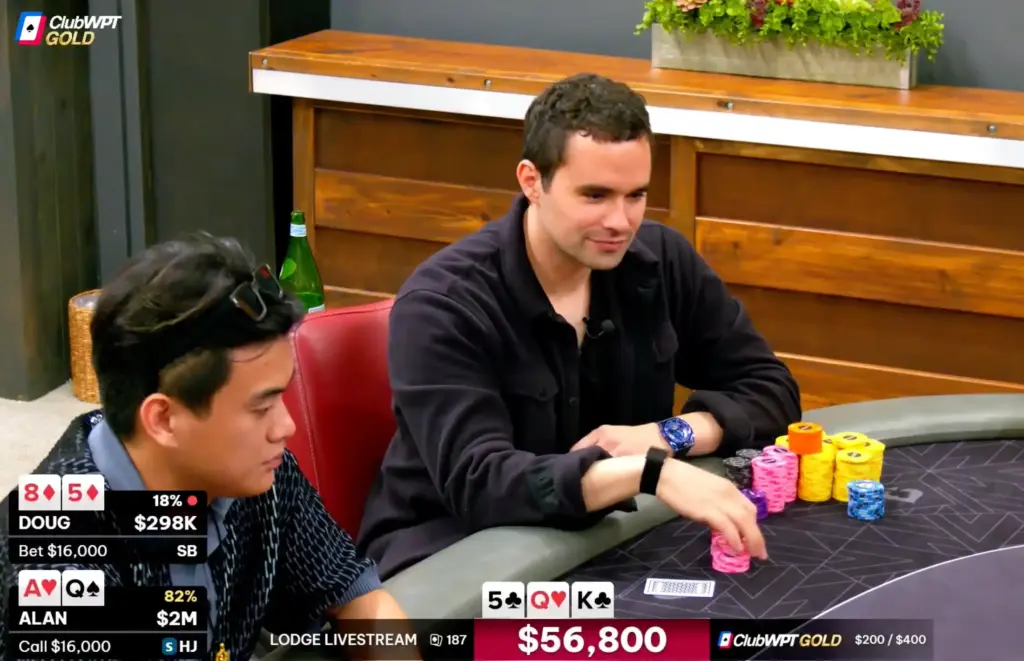
The flip card, the 8, dramatically improved Polk’s hand. What had been a comparatively customary continuation guess spot out of the blue become a price scenario, as Polk improved to 2 pair. Quite than selecting a traditional sizing, Polk reached for an aggressive overbet of $85,000 into the $56,800 pot. The sizing instantly put most strain on Keating’s one-pair holdings and compelled him to determine on a probably large pot.
Remarkably, Keating barely appeared fazed. After a quick have a look at the board and his opponent, he made the decision, organising a river that might finally produce the biggest pot of the complete livestream.
Why Doug Polk’s Flip Overbet Was so Attention-grabbing
At first look, Doug Polk’s $85,000 guess right into a $56,800 pot appears like a traditional bluff. In spite of everything, most leisure gamers affiliate giant overbets with makes an attempt to power folds and win pots with no showdown. Trendy money recreation technique tells a special story.
In at the moment’s video games, overbets are generally used with each robust worth arms and punctiliously chosen bluffs. The aim isn’t merely to make an opponent fold, however to place most strain on the a part of their vary that forces them to make a really tough resolution.
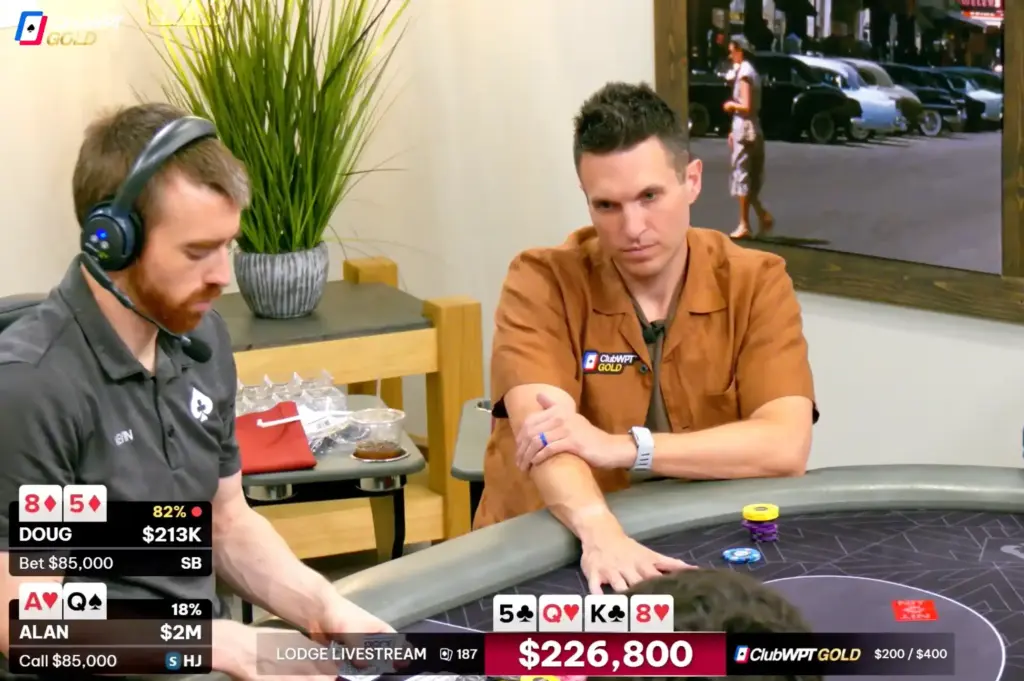
After the 8 landed on the flip, Polk improved from backside pair to 2 pair. Whereas his hand was now fairly robust, it remained susceptible to quite a lot of river playing cards. Flush and straight attracts had been nonetheless obtainable, and lots of one-pair arms may nonetheless enhance.
By selecting a 1.5x pot overbet, Polk completed a number of issues without delay. He instantly extracted worth from robust kings, queens, and drawing arms whereas concurrently making it extraordinarily tough for his opponents to proceed with marginal holdings.
From Alan Keating’s perspective, the scenario was removed from snug. Holding AQ, he had a fairly robust bluff catcher, however he was now dealing with a sizing that usually represents a really polarized vary. Polk was successfully saying that he both had a really robust hand or a bluff highly effective sufficient to resist most strain.
This is without doubt one of the causes the hand turned so attention-grabbing from a strategic perspective. The overbet wasn’t merely about constructing a much bigger pot. It pressured Keating to assume when it comes to ranges somewhat than particular person arms, a dynamic that might grow to be much more vital as soon as the river card arrived.
Was Alan Keating’s River Name Truly Unhealthy?
The river introduced the three, a whole clean. Flush and straight attracts missed. After a quick pause, Doug Polk moved all-in, placing Alan Keating to the final word check.
Holding AQ on a OkQ583 board, Keating had only one pair. In opposition to a price hand, he was overwhelmed; towards a bluff, he would win. This precise situation is what gamers name a bluff catcher, a hand that beats bluffs however loses to worth bets. The problem is figuring out if the opponent is bluffing ceaselessly sufficient.
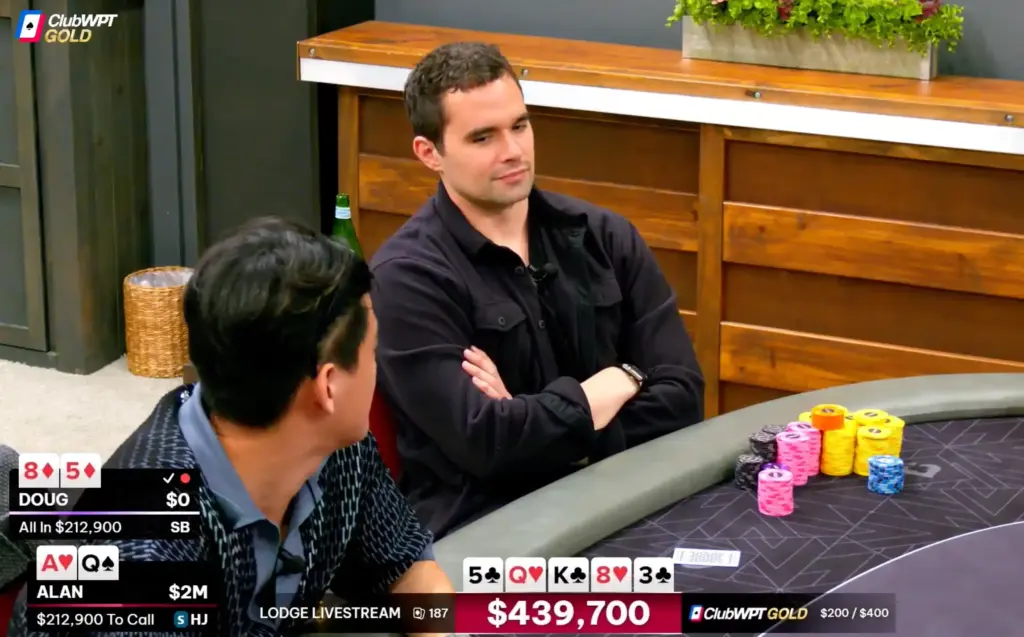
Theoretically, Keating’s scenario was grim. Polk’s aggressive line, a preflop squeeze, half-pot flop c-bet, large flip overbet, and river shove, represented excessive energy, simply containing units, two pairs, or premium arms like AK.
Nevertheless, Polk is thought for making use of relentless strain the place others play conservatively. This popularity alters the dynamic. When analyzing any Alan Keating poker resolution, we should do not forget that whereas a solver evaluates ranges mathematically, stay poker takes the human ingredient under consideration. Keating’s name doubtless relied much less on the uncooked energy of AQ and extra on his particular learn, suspecting sufficient missed attracts and bluffs remained in Polk’s vary to justify calling.
In the end, Polk turned two pair and was forward, successful the large pot. But, this hand completely illustrates the conflict between mathematical principle and real-world reads in high-stakes choices.
What Can Leisure Gamers Be taught From This Alan Keating Poker Hand?
Most gamers won’t ever discover themselves concerned in a $650,000 pot, however the strategic ideas from this hand apply at each stake degree.
Overbets Are Not At all times Bluffs: The primary lesson is that giant bets don’t routinely imply a participant is bluffing. Many leisure gamers see an overbet and instantly assume their opponent is attempting to power a fold. In actuality, robust gamers usually use giant sizings with each worth arms and bluffs like GTO do.
Understanding the Bluff Catcher: The second takeaway is the significance of understanding this idea. Alan Keating’s AQ was robust sufficient to beat missed attracts and bluffs, however not robust sufficient to beat most worth arms. Conditions like this power gamers to assume when it comes to ranges somewhat than particular person holdings.
Keep Goal In opposition to Aggression: Lastly, this hand highlights the significance of remaining goal when dealing with aggression. Whether or not you determine to name or fold, the choice needs to be based mostly in your opponent’s doubtless vary, not on a need to “catch them bluffing”.
Whereas Doug Polk received this specific battle, the hand serves as a superb reminder that nice poker choices are not often in regards to the playing cards alone. They’re about understanding ranges, guess sizing, and the story every participant is attempting to inform all through the hand.
Closing Ideas
The most important pot of the evening could have gone Doug Polk’s method, however the hand itself supplied way more than an entertaining showdown. It showcased how fashionable high-stakes money video games are sometimes determined by strain, guess sizing, and vary building somewhat than merely who holds the higher playing cards.
Polk’s large flip overbet demonstrated how elite gamers use polarized sizing to place opponents in tough conditions, whereas Keating’s willingness to name down with a single pair highlighted the arrogance and instinct which have made him probably the most talked-about gamers in streamed poker.
In the long run, Polk collected the $650,000 pot, however Alan Keating nonetheless completed the session as the largest winner by a substantial margin. For poker followers, that made the hand an ideal snapshot of what makes high-stakes money video games so fascinating: one pot can create the headline, however a full session is what in the end determines the winner.
Try the ultimate revenue and loss numbers from this extremely wild high-stakes session beneath:
Able to Hit the Tables?
If studying this bought you within the temper to play some poker your self, it is very important select a safe and trusted platform. Now we have rigorously evaluated and chosen one of the best locations to play, making certain you possibly can benefit from the recreation in a very secure setting. Try our checklist of the highest on-line poker websites to seek out the right room to your wants and be part of the motion at our verified companions at the moment!
FAQ About this Alan Keating Poker Hand
A bluff catcher is a hand that’s comparatively weak within the grand scheme of issues, which means it is going to lose to nearly all the opponent’s value-betting arms, however it’s robust sufficient to beat their pure bluffs. On this hand, Alan Keating’s AQ on the river was a traditional bluff catcher, because it may solely win if Doug Polk was fully bluffing.
In fashionable GTO methods, overbets are used to polarize a participant’s vary. By betting $85,000 right into a $56,800 pot, Polk was signaling that he both had a monster hand (like the 2 pair he truly held) or a whole bluff. This sizing places most strain on marginal arms and extracts the best potential worth when the opponent calls.
Surprisingly, no. Regardless of shedding this large $650,000 pot to Doug Polk, Keating’s aggressive and unconventional playstyle paid off immensely over the eight-hour session. He completed the evening as the largest winner by far, reserving over $1,041,000 in complete revenue.
This epic hand happened throughout a high-stakes money recreation on The Lodge Livestream. You possibly can watch the complete hand play out, full with the participant reactions and desk speak, by trying out the video embedded within the article.
The put up Doug Polk Wins $650,000 Pot In opposition to Alan Keating at The Lodge appeared first on My Poker Teaching.
Source link