

Having lined plenty of essential methods for tournaments, immediately’s lesson will concentrate on a considerably narrower however nonetheless essential space of the sport: paired boards.
In earlier classes, we talked about various kinds of dry and draw-heavy textures, that includes aces, broadways, and low playing cards.
At this time’s article will probably be all about tailoring your in-position match technique as a preflop raiser on various kinds of paired flops. We’ll be specializing in the commonest state of affairs of elevating from the button and getting a name from the large blind.
Earlier than we proceed to consultant examples of those eventualities, listed below are a number of most important takeaways:
Continuation guess 100% of flops containing a pair of aces, utilizing 25% of the pot sizing
C-bet small & at all times on high-pair boards with a low kicker
On high-pair boards containing an ace, c-bet round 80%
Use solely small sizing on low pair boards & c-bet at round 60%
Tip #1: C-Wager Ace-Paired Flops 100%, Largely Utilizing Small Sizing
By way of complexity, our technique on flops that includes a pair of aces will probably be fairly easy, as these are the boards we’ll be c-betting 100% of the time as soon as the large blind checks to us.
In commonest eventualities, the place we’re taking part in round 40 huge blind efficient, our go-to sizing on some of these boards will probably be a small, quarter-pot continuation guess, as we are able to see on the instance of A♠A♥6♦:
At 60 huge blinds deep, our technique doesn’t actually change, as we’re nonetheless c-betting each time. We’re utilizing the larger sizing barely extra usually, betting 67% of the pot round 13% of the time, primarily with fingers like AK all the way down to A7 and a few weaker backdoor attracts like JTo, T9o, and T7o.
As soon as the efficient stacks get to 25 huge blinds, it’s fascinating that the solver begins utilizing the bigger sizing extra steadily, betting 60% of the pot at a frequency of over 28%:
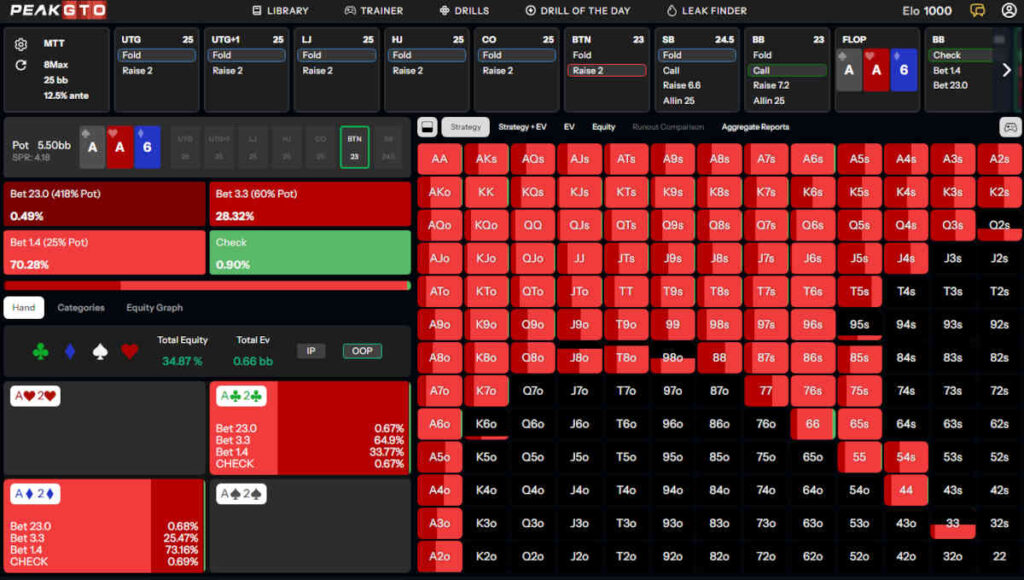
The vary of fingers that we’re betting huge with expands to all high pairs (round one-third of the time), balancing it out by including some additional backdoor attracts to the combination.
With shallower stacks, we’re completely pleased to get chips within the center with all sturdy fingers, however to realize the correct stability, we have to develop our vary to incorporate extra weak fingers as properly. In any other case, our technique can be simply exploitable.
It’s essential to notice, nevertheless, that the small, 25% pot guess continues to be our default choice in these eventualities, and we’re utilizing it virtually with no exceptions with all sturdy non-made fingers, like KJ, KQ, KT, QJ, and so forth.
Tip #2: Wager Small & At all times on Excessive Pair Flops
In terms of flops containing a excessive pair, similar to Ok♠Ok♥5&golf equipment;, our technique at 40 huge blinds is even easier. You’ll need to c-bet these textures 100%, and you need to be utilizing 25% of the pot sizing with none exceptions:
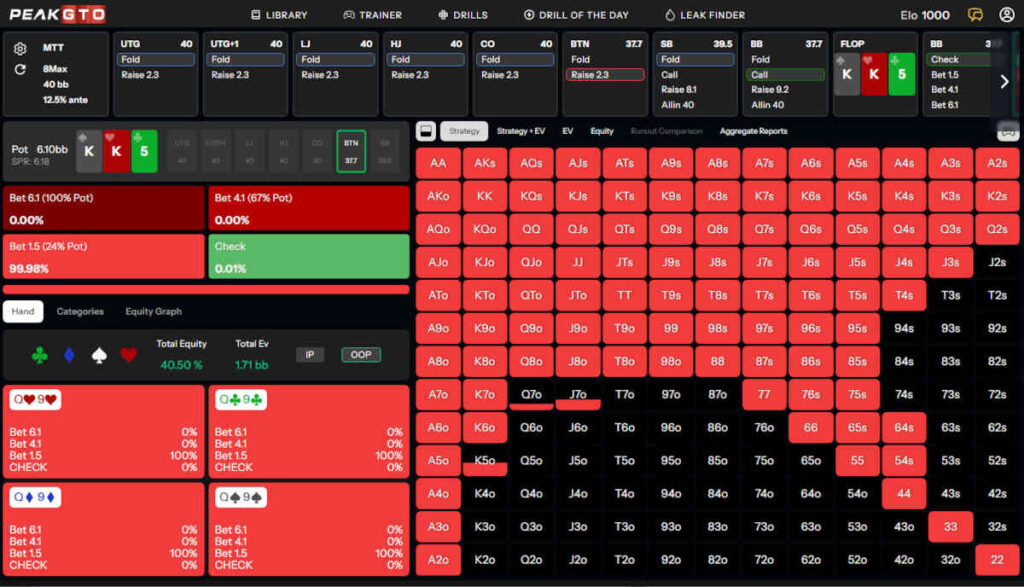
It is very important notice that this technique applies throughout all high-pair boards with low kicker, i.e. KKx, QQx, JJX, and even TTx. On flops containing a pair of queens particularly, we’re checking again round 10%, primarily doing so with QQ, pocket aces, and pocket kings, after which a wide range of fingers at very low frequencies:
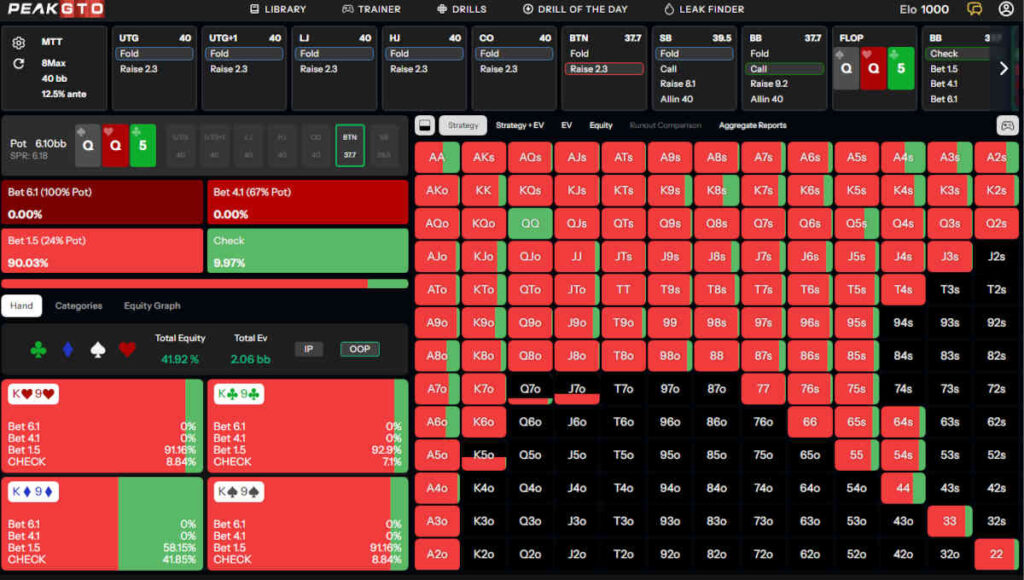
It’s fascinating that the GTO technique at efficient stacks of 60 and 25 huge blinds doesn’t change in any respect, so we’re nonetheless betting all high-paired boards at 100% utilizing a small sizing.
The one state of affairs the place we’ll be checking again at some frequency as a substitute of c-betting is on flops that includes a excessive pair and an ace. For instance, on a board like A♦Ok♠Ok♥, we’ll be persevering with round 80% and checking again about 20%:
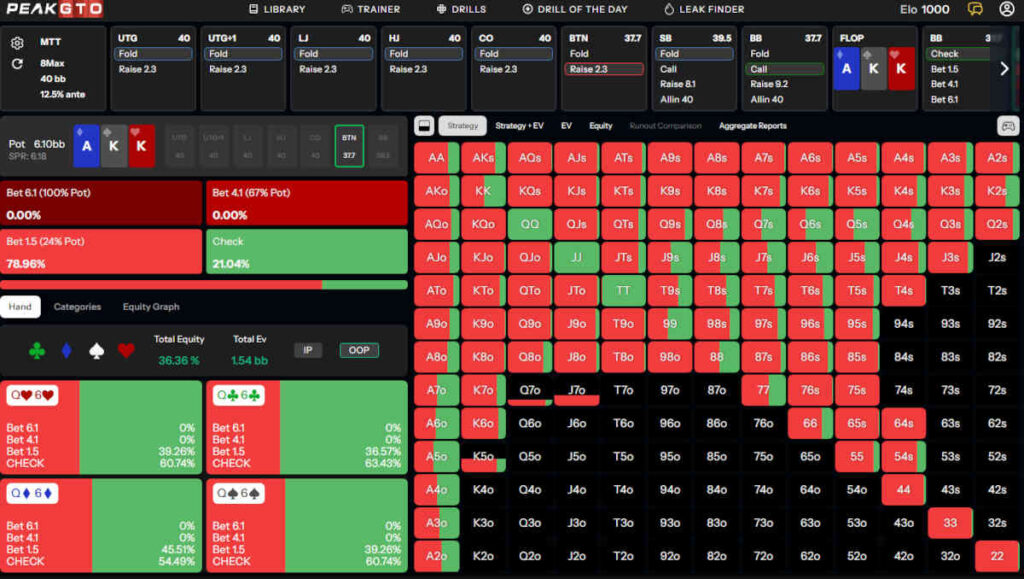
As you may see, the fingers that we’re checking again at some frequency (10% – 30%) are primarily fingers containing an ace in addition to pairs like QQ, JJ, and TT, which we’re checking again 100% to guard our fairness and attempt to attain an inexpensive showdown.
Tip #3: Proceed round 60% on Low Pair Flops
Flop textures containing a low pair and one other decrease card are often extra favorable to the large blind participant than the button raiser. Thus, on a board like 6♠6♥2&golf equipment;, we’ll be c-betting solely round 65% of the time:
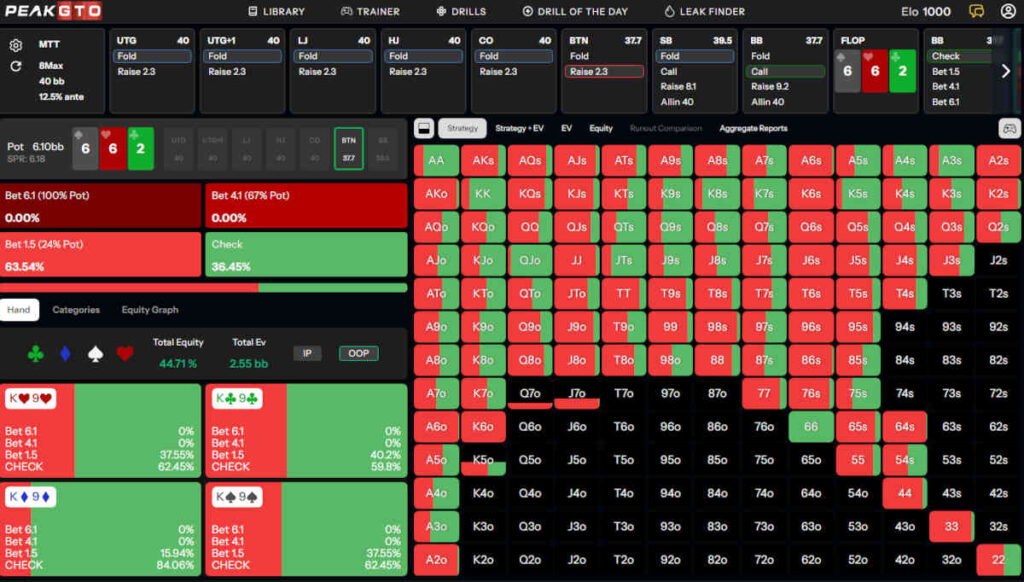
As you may see, we’re at all times utilizing the small, quarter-pot guess in these conditions, and our c-bet vary is sort of unfold out. Fingers that we’re c-betting 100% are those containing a six and virtually all pocket pairs, however we’re additionally persevering with with a good share of suited fingers containing overcards, similar to AK, AQ, AJ, KJ, QJ, TJ, and so forth.
As for the checking vary, it incorporates a whole lot of off-suit ace-high and king-high combos.
A totally GTO-approved technique in these eventualities is sort of advanced, however no less than you don’t must take care of totally different guess sizings, which makes issues a bit simpler. You may also make issues easier by eradicating any fringe frequencies and including them to different combos.
For instance, J8o c-bets at a really excessive frequency in these spots and checks again solely a fraction of the time. You may make memorizing a bit simpler by at all times c-betting J8o and checking again barely extra with JTs, a hand that’s already virtually solely within the check-back bucket.
As for the 60 huge blind technique, it stays just about unchanged. The one seen change is that the solver throws in a tiny share of bigger c-bets with a number of combos, however these are so small and rare that you simply don’t must memorize them.
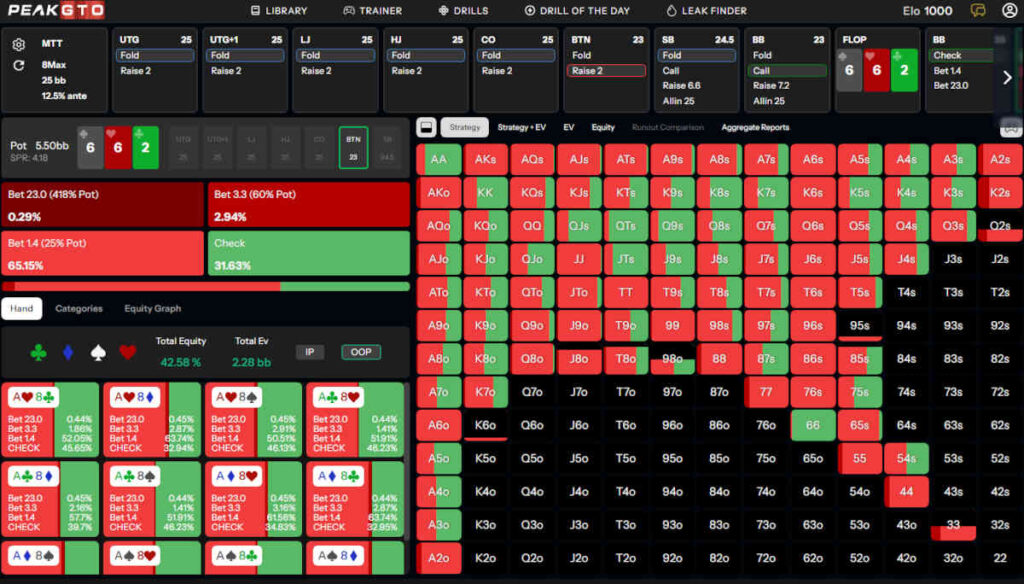
Lastly, at 25% huge blinds efficient, our c-bet frequency will increase a little bit bit, going as much as virtually 69%. It’s a small change, however you’ll discover how, at this stack depth, all of our pocket pairs turn out to be necessary c-bets, and our c-betting frequency with A-x fingers is barely increased as properly:
The publish MTTs: Final GTO Technique for Enjoying Button vs. Massive Blind on Paired Flops appeared first on My Poker Teaching.
Source link